
Community Ownership and Behaviour Change at the Heart of Sustainable Development: Alliance for Behaviour Change Organises a Learning and Dialogue Programme in Bilaspur
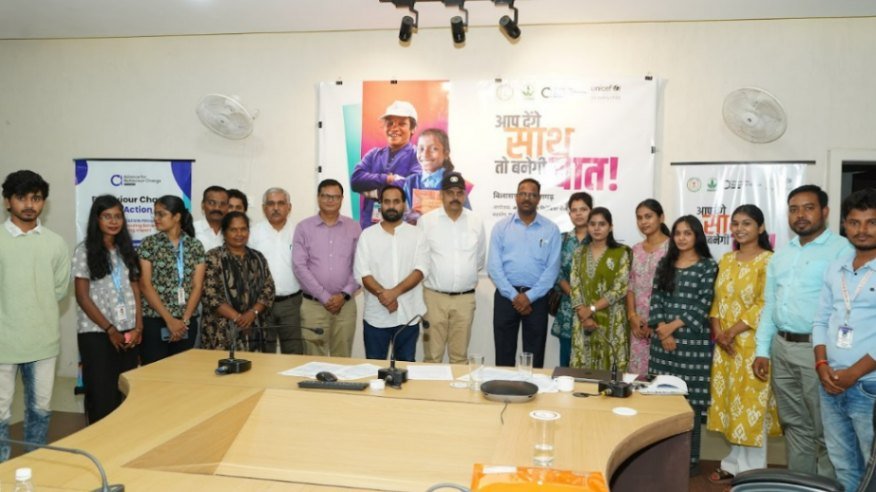
Emphasising that sustainable development begins when communities become active participants in their own development, the Alliance for Behaviour Change, Chhattisgarh, in collaboration with Prakriti Seva Sansthan and UNICEF, organised a learning and dialogue programme in Bilaspur. The programme brought together government officials, development professionals and community stakeholders to deliberate on community ownership, behaviour change, education, waste management and people-led development.
The discussions highlighted that providing information alone is not enough to bring lasting change. Meaningful transformation requires understanding people's behaviours, strengthening community participation and enabling individuals and institutions to work collectively towards shared goals.
Addressing the participants, Shri Sandeep Agrawal (IAS), Chief Executive Officer, Zila Panchayat, Bilaspur, spoke about the importance of behaviour change and community-level action, highlighting waste management as a critical area where individual responsibility and collective community efforts are essential. He emphasised that sustainable waste management practices require people to actively participate and take ownership of their surroundings.
Shri Sanjay Agrawal (IAS), Collector, Bilaspur, highlighted the importance of governance and behaviour in driving development outcomes. The discussions underscored that government initiatives become more effective and sustainable when communities understand, participate in and take ownership of the process of change.
Speaking on the role of education in development, Mr Abhishek Singh, SBC Specialist, UNICEF, discussed the interconnected dimensions of education, including accessibility, quality, retention and participation. He encouraged participants to look beyond enrolment and understand the behavioural and social factors influencing why people do what they do. He emphasised the need to understand people's motivations, perceptions and circumstances to design interventions that address the actual barriers to educational participation and retention.
Mr Chandan Kumar, SBC Consultant, UNICEF, spoke about the power of collective influence and how behaviour change can begin with small groups of people. Through the idea of how 100 people can influence another 100, he illustrated how individuals can become agents of change, inspire others and create a wider ripple effect. He highlighted the potential of communities working together to adopt and sustain positive behaviours.
A key session was facilitated by Ms Nidhi, Project Coordinator – Mental Health, Agricon, on the Process of People-Led Development. The session explained how projects should be designed with meaningful community participation rather than being planned entirely from the outside. The process covered introduction and rapport building, identification of potential leaders, concept sharing, situational analysis, prioritisation of needs, sensitisation, group formation, micro-planning, implementation, capacity building, group functioning, and monitoring and evaluation. The session reinforced that communities should not merely be beneficiaries of development programmes but active contributors and decision-makers throughout the project cycle.
The programme also featured an interactive session led by Ms Sristi Choubey, Consultant, Sarvhitam, who engaged participants to understand perspectives and experiences around behaviour change. The discussions encouraged participants to reflect on the importance of moving beyond information-sharing towards interventions that influence everyday practices.
The programme began with a welcome and introduction by **Dr Rajeev Awasthi, Chairman, Prakriti Sewa Sansthan, Bilaspur, and included participation from Shri Suresh Kumar Singh, District Programme Officer (DPO), Women and Child Development (WCD), Bilaspur. The sessions provided a platform for exchanging experiences, discussing local development challenges and exploring practical ways to strengthen collective action.
Concluding the programme, Mr Raghavendra Kumar, Project Manager, Alliance for Behaviour Change, Chhattisgarh, encouraged participants to carry forward the learnings and translate discussions into collaborative action. He highlighted the Alliance as a platform for connecting organisations, professionals and institutions to strengthen behaviour change initiatives across the state.
NGOs partners who are associated with ABC from Bilaspur division from districts Mungeli, GPM, Korba, Janjgir-Champa, Sakti, Raigarh , Sarangarh- Bilaigarh also participated
The programme reiterated a shared understanding: development becomes sustainable when people are not just informed about change but are empowered to lead it. By bringing together governance, community participation and behavioural insights, the Alliance for Behaviour Change continues to promote a collaborative approach to creating lasting social impact.
आप देंगे साथ, तो बनेगी बात!
Alliance for Behaviour Change, Chhattisgarh